How to Reduce No-Shows on Training Courses
Payment at booking, reminders, a cancellation policy delegates will use, and a waitlist: how each one cuts no-shows on training courses.
On this page
- Key takeaways
- 1What the numbers say about no-shows
- 2Lever 1: take money when the seat is booked
- 3Lever 2: reminders that actually land
- 4Lever 3: a cancellation policy you can enforce
- 5Lever 4: make moving easy, and backfill the seat
- 6The special case: free courses, tasters and funded places
- 7Which lever to pull first
- 8Measure it before and after
- 9Where the booking system does the work
- 10Frequently asked questions
- 11Stop the leak on your next date
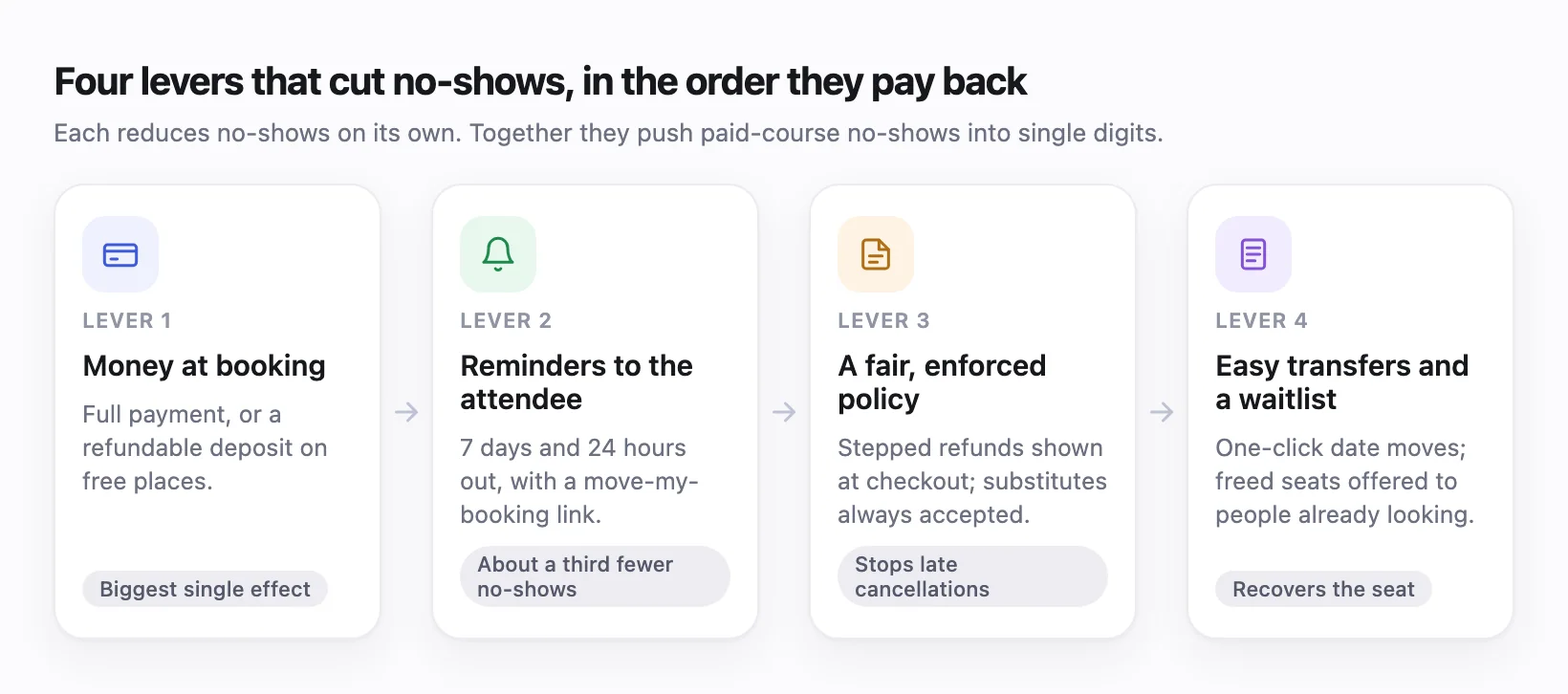
To reduce no-shows on training courses, take payment (or a deposit) when the seat is booked, send reminders on a fixed schedule with a one-click way to move or cancel, publish a cancellation policy you actually enforce, and keep a waitlist to refill any seat that frees up. Payment is the biggest single lever: across 860+ events with check-in data, free events lost a median 28% of registrants on the day and paid events 17%. On Cademy, free public seats went unused at 18.4% in 2025 against 5.7% for paid seats.
Key takeaways
- Money at booking is the strongest predictor of turning up. A refundable deposit works almost as well as full payment.
- Reminders cut non-attendance by roughly a third in controlled studies. Send at least two, the last one 24 hours out, with the venue, timing and a way to cancel.
- A cancellation policy only reduces no-shows when it is visible at checkout, fair under UK consumer law and applied every time.
- A no-show you hear about in advance is a seat you can resell. Make moving dates easier than vanishing, and keep a waitlist to backfill.
What the numbers say about no-shows
People who have paid turn up. People who have not paid turn up a lot less. Every dataset we found shows the same gap.
Two details from the PheedLoop analysis matter for how you design your booking flow. Among paid events the no-show rate sat flat at 16 to 19% however easy or hard the registration form was, so friction in the form made no difference once money was involved. An addendum published in September 2026 found that at mixed events, paying attendees showed up 2 to 4 percentage points more reliably than non-paying attendees at the same event. The gap is partly about who books a free seat in the first place, and partly about the commitment the payment creates.
Reminders are the second lever with hard evidence behind it. In a London hospital eye clinic, patients who received an SMS reminder failed to attend 11.2% of the time, against 18.1% for patients who received nothing: a 38% reduction. A systematic review of reminder studies across medical settings found an average 41% cut in missed appointments. Training courses are a different setting, but people forget a course date the same way they forget an appointment, and a nudge at the right moment fixes both.
Most public seats are booked less than three weeks before the course runs, so there is last-minute demand to backfill a freed seat if you find out about it in time.
Lever 1: take money when the seat is booked
Charge for the seat at checkout. Full payment is the norm for public courses and it is the reason paid no-show rates sit in the single digits to high teens rather than the thirties. If your buyers are companies who book on account, take a card for the seat anyway and invoice separately for anything extra, or at minimum require a purchase order number at booking so someone at the buyer’s end has committed.
Use a refundable deposit for anything you want to keep free. In September 2026, Basecamp’s Jason Fried ran a breakfast event in Chicago that had previously been free. The free version drew 84 registrations and 38 attendees, a 45% show rate. The next one asked for $100 at registration, handed back in cash at the door to everyone who came. Registrations fell to 55, attendance rose to 50, a 90% show rate. A deposit of £20 to £50 does the same job for a taster session or a funded course, and you can refund it, credit it against the full course or donate it, as long as the terms say so up front.
Deposits on expensive courses do double duty. For a multi-day or accredited course priced in the hundreds or thousands, a deposit of 20 to 30% at booking with the balance due a set number of days before the start date means the learner has committed and you know before the course starts whether the balance has arrived.
Lever 2: reminders that actually land
Reminders fail when they go out once, weeks early, or when they go to the wrong person. A company training coordinator who booked six delegates will read your reminder. The six delegates, who are the ones who need to be on the M6 at 8am, may never see it. Collect a contact for each attendee at booking, and remind the attendee as well as the buyer.
- 1Booking confirmation, immediately
Date, start time, venue with a map link, what to bring, and the cancellation terms in plain words. This is the message people search their inbox for later.
- 2Seven days before
A short reminder with the same essentials plus a one-click 'I can't make it, move me' link. This is the message that recovers seats in time to resell them.
- 324 hours before
Send by SMS if you have a mobile number, otherwise email. Start time, venue, parking or joining link, who to call on the day.
- 4Morning of, for early starts and online courses
Joining link or room number, and nothing else.
The channel matters less than the reminder itself. In a study of 1,193 dental appointments where patients chose their own reminder method, SMS produced a 1.9% no-show rate, email 2.7% and phone calls 3.5%, and the difference was not statistically significant. SMS edges it for the 24-hour message because it gets read within minutes, and email is fine for everything else. Let people pick if you can.
Every reminder should contain a route out. A learner who cannot come and sees a “move my booking” link will use it. One who has to phone you during office hours to cancel often just does not turn up.
Lever 3: a cancellation policy you can enforce
A policy reduces no-shows only if learners see it before they book and you apply it the same way every time. A rule that gets waived whenever someone rings up loses its effect within a few months, because word gets round.
Make it fair, or it will not hold. For consumers in the UK, the Consumer Contracts Regulations give a 14-day cancellation right on most distance and off-premises contracts, and the Competition and Markets Authority’s guidance on unfair terms is clear that a business can generally only keep an amount that reflects the loss the cancellation actually caused, and is expected to take reasonable steps to reduce that loss, for instance by reselling the seat. A “no refunds under any circumstances” line in your terms does not become fair by being signed. Tiered policies that step down as the course date approaches are the standard for exactly this reason. The example below is illustrative and is not legal advice. Check your own terms with a solicitor if you sell to consumers.
| Notice given before the course | Typical outcome |
|---|---|
| More than 28 days | Full refund, or free transfer to another date |
| 15 to 28 days | Transfer for free, or refund minus an admin charge |
| 8 to 14 days | Course credit or transfer; refund only if the seat is resold |
| 7 days or fewer | No refund; a substitute delegate is accepted |
| Did not attend | Full fee remains payable |
Always allow a substitute. A different person in the seat costs you nothing and is the easiest concession you can make. Public-sector providers use the same shape: Bradford Council’s workforce development service, for example, gives a full refund with 15 or more days’ notice and none below 14.
Put the policy where the money changes hands. Show it at checkout, in the confirmation email and in the seven-day reminder. A terms page linked from the footer is not enough on its own.
Lever 4: make moving easy, and backfill the seat
Every no-show is a seat you could have resold if you had known in time.
Make a transfer easier than a no-show. If moving to the next date takes one click from the reminder email, most people who cannot come will take it. If it takes an email, a wait for a reply and a manual amendment on your side, they will let the date pass. Free transfers with reasonable notice cost you nothing when you were going to lose the seat anyway.
Run a waitlist on every date that fills. With a median booking lead time of 18 days, a seat that frees up ten days out has a real chance of being resold to someone who was already looking. Capture waitlist entries on full dates, and when a transfer or cancellation comes in, offer the seat to the list before anyone else. For courses that regularly fill, a waitlist also tells you when to add a second date.
Do not overbook to compensate. Overbooking works for airlines because they can compensate a bumped passenger and the capacity is fungible. A learner turned away from a first-aid course they paid for is a refund, a complaint and a review.
The special case: free courses, tasters and funded places
Expect a 30 to 50% drop-off and size the room accordingly. Webinar platforms see 57 to 60% of registrants attend a free session. Free in-person events cluster around a 28% median no-show, with some benchmark round-ups putting the range at 40 to 60%. Plan catering and materials for the lower figure.
Ask for a refundable deposit. Even a small one changes who registers, as the Basecamp breakfast showed.
Cap registrations and ask people to confirm a week out. A “confirm your seat” click in the seven-day reminder lets you release unconfirmed seats to a waitlist.
For funded or employer-sponsored places, tell the learner what a no-show costs. When the learner pays nothing, the funder or employer usually still does. Saying so in the reminder (“this place is funded at £180; if you can’t attend, let us know so someone else can use it”) is more effective than any penalty you cannot actually charge.
Which lever to pull first
The first lever to pull, based on how you sell today
Refundable if you want to stay free in spirit. This is the change that moves the number most.
Seven days and 24 hours out, with a move-my-booking link.
A stepped refund policy shown at checkout, substitutes always accepted.
Backfill freed seats from people already looking, and use it to decide when to add dates.
Measure it before and after
You cannot tell whether a change worked without a baseline. Track these two figures for each course:
- No-show rate = seats booked and not attended ÷ seats booked. Count a late cancellation (inside your notice window) separately from a silent no-show, because the fixes are different.
- Recovery rate = freed seats that were resold ÷ seats freed. This is the number the waitlist and transfer changes move.
Split both by whether the seat was paid, free or funded, and by course type. A 15% no-show rate on free tasters and 4% on paid accredited courses is a healthy pattern hiding inside a misleading 9% average. Review monthly for a quarter after each change.
Where the booking system does the work
Most of what is above is process, and you can run it from a spreadsheet and a calendar for a while. What breaks at scale is anything that has to happen on time for every booking. The 24-hour reminder, the deposit before the seat is confirmed and the waitlist offer the moment a seat frees up are the jobs a booking system exists to do. Cademy takes deposits at checkout with the balance settled later, sends learners automated reminder emails before their course runs, and lets you add people to a waitlist on a full date so a freed seat has somewhere to go. If your courses are mostly booked by companies for other people, it is worth checking that whatever you use collects the attendee’s details as well as the buyer’s, or the reminder never reaches the person who needs it. What each type of booking tool covers, and what it costs, is in our guide to course booking software. Filling the seat in the first place is a bigger topic, covered in our guide to filling your training courses.
Frequently asked questions
What is a normal no-show rate for a training course? Paid public courses typically run between 5% and 17%, depending on the source and the price point. Free courses and tasters run two to three times higher, with medians around 28% and some benchmarks reporting 40 to 60%. On Cademy in 2025, paid public seats went unused 5.7% of the time and free public seats 18.4%.
Can I charge a no-show fee in the UK? You can keep money that reflects your actual loss from the cancellation, and you are expected to try to reduce that loss by reselling the seat. A stepped policy that reduces the refund as the course approaches, shown before purchase, is the common and defensible approach. A blanket “no refunds” term may be unenforceable against consumers under the CMA’s unfair terms guidance. Take advice on your own terms.
How many reminders should I send? Three works for most courses: confirmation at booking, a reminder seven days out with a transfer link, and a reminder 24 hours out. Add a morning-of message for early starts and online courses. More than that starts to get ignored.
Do reminders work if the course is free? Yes, but less. A reminder fixes forgetting, and forgetting is only part of the problem with a free place, where the learner has committed nothing. Pair reminders with a refundable deposit or a “confirm your seat” step.
Should I overbook to allow for no-shows? Not for paid courses. Turning away a paying learner costs more than an empty seat. Reduce the no-show rate and backfill from a waitlist instead.
Stop the leak on your next date
Pick the course date with the worst attendance in the last three months and apply one lever to the next run of it: a deposit if it is free, a 24-hour reminder to attendees if it is paid. Count the no-shows before and after. Cademy’s booking system takes the deposit, sends the reminders and runs the waitlist without you having to remember any of it.
Sources
- PheedLoop Event Data Lab Report #06: Does easier registration lead to more no-shows? (May 2026, addendum September 2026)
- Skift Meetings: The $100 experiment that slashed no-show rates to just 10% (September 2026)
- Koshy et al., Effectiveness of SMS reminders for ophthalmology outpatient appointments, BMC Ophthalmology (2008)
- Measuring the effectiveness of patient-chosen reminder methods in a private orthodontic practice (2018)
- The effect of patient reminders in reducing missed appointments: a systematic review
- ON24, Key takeaways from the 2025 Webinar Benchmarks Report
- Nunify, Event attendance rate statistics and benchmarks (free-event range attributed to Event Tech Live)
- accessplanit, How to create a training course cancellation policy (UK consumer law summary and example tiers)
- Bradford Council, Workforce development cancellation policy
- Cademy booking data, public seats, 2025 (first-party; no-show share of free vs paid seats, median booking lead time)