How to Price Your Training Courses
The five pricing models for training courses, how to find your cost floor and value ceiling, market day rates, tiering, discounts and raising prices.
On this page
- Key takeaways
- 1Why your price is the most important number in your business
- 2The five ways to price a training course
- 3Step 1: Work out your true cost per seat
- 4Step 2: Price to the outcome, not the hours
- 5Step 3: Benchmark against your market
- 6Where in the band you can sit: expertise and competition
- 7Step 4: Choose the model that fits how you sell
- 8Step 5: Use tiers, the biggest lever you are not pulling
- 9Protect your price: discounts, deposits, and cancellations
- 10When and how to raise your prices
- 11Grow the revenue behind each course
- 12The method on one page
- 13Common pricing mistakes
- 14Frequently asked questions
- 15Holding the price in the booking system
To price a training course, set a floor from what it costs you to deliver, a ceiling from what the outcome is worth to the learner, and pick a model to charge in between.
Key takeaways
- Price in order: cost sets the floor, the outcome sets the ceiling, and you choose where to sit between them.
- Never price by feel. A number that “sounds about right” is almost always too low, and underpricing compounds for years.
- Pick a model that matches how you sell: per seat, tiered, subscription, corporate day rate, or value-based.
- Tiering is the most underused lever. One course, packaged three ways, wins the budget buyer and the premium buyer at once.
- Going rates vary by region but cluster in a familiar band. Benchmark against your own market rather than a converted average.
- Revisit your price at least once a year. A price set three years ago is almost certainly too low.
Why your price is the most important number in your business
Ask a room of training providers how they set their prices and many will admit the same thing. They looked at a competitor, or at what they charged last year, and nudged it to something that felt reasonable. It is an expensive shortcut.
A price set by feel almost always drifts low, and then it stays low. Raising it later feels riskier than leaving it alone, so a number chosen casually in year one can still be dragging on your margins in year five. Every course you run at that price is a permanent discount on work that has got better since you set it.
Pricing low feels like the safe choice when it is usually the opposite. A low price attracts the buyers most likely to haggle, cancel or not turn up, and it signals low quality to the serious ones. Buyers in developed markets already expect professional training to cost real money. The alternative is to build the number up from your costs and the value you create.
The five ways to price a training course
Before you settle on a number, decide how you are going to charge for it. Most training pricing is a variation on five models, and they are not mutually exclusive. Many providers run two or three at once for different audiences: a per-seat price for individuals, a day rate for corporate clients, and a subscription for their on-demand library.
| Model | How it works | Best for |
|---|---|---|
| Per seat | A fixed price per person, per course | Public and open courses sold to individuals |
| Tiered | Good, better, and best packages at rising prices | Courses with natural add-ons: materials, certification, support |
| Subscription / membership | A recurring fee for ongoing access | CPD libraries, on-demand catalogues, professional bodies |
| Corporate / bulk | A day rate or per-cohort fee for a whole team | In-house and closed courses delivered to one client |
| Value-based | A price set by the outcome, not the hours | Certification, compliance, and high-stakes skills |
Per seat is the simplest and the default for open enrolments. You publish a price and people book. Its weakness is that a single number has to work for every buyer, which is the problem tiering solves.
Tiered pricing takes the same course and offers it at three levels, each adding something the buyer values. It is the most powerful model for individual sales (Step 5 covers it).
Subscription suits providers with a deep, growing catalogue rather than one-off courses. It trades a higher upfront price for predictable recurring revenue, and it rewards you for continually adding content. It only works if you keep the library fresh.
Corporate or bulk pricing is how you sell to organisations. You charge a day rate for delivering a closed course to one client’s team rather than a per-person fee, which changes the economics (see Step 3).
Value-based pricing sets the number by the outcome. A one-day compliance course that keeps a company on the right side of a regulator is worth more than its hours suggest, and value-based pricing is how you capture that. It demands that you can show the outcome, so it rewards providers with proof: certifications, pass rates, testimonials.
Step 1: Work out your true cost per seat
You cannot price a course you have not costed, so every pricing decision starts here. The trap is counting only the trainer’s time in the room and forgetting everything wrapped around it.
| Cost | What to include |
|---|---|
| Trainer time | Prep, travel and follow-up as well as the hours in the room |
| Venue & logistics | Room hire, catering, equipment, or the platform for online delivery |
| Materials | Workbooks, assessments, certificates, licensing of third-party content |
| Accreditation & certification | Awarding-body and centre-approval fees, and per-learner registration or certificate fees (First Aid, CPD, Ofqual, IOSH, food hygiene). Often the biggest per-seat line if you are regulated |
| Admin | Booking, invoicing, reminders, rescheduling, chasing payments |
| Platform & payment fees | Booking software, payment processing, any per-transaction cut |
| Marketing | The cost of filling the seat: ads, email, and your own time spent selling |
| No-shows | Empty seats you can’t resell, a real cost that is easy to ignore |
Divide by the seats you realistically fill. This is where cost calculations usually go wrong. Suppose a one-day course costs you around £1,400 to put on: roughly £700 in trainer time across prep, delivery and follow-up, £280 for venue, catering and materials, £200 for admin, booking and payment fees, and £220 to market it and fill the seats. If the room holds 12 but you reliably fill 8, your true cost per seat is £175, where a full room would suggest £117. If you are accredited, add your awarding-body and per-certificate fees to that total before you divide. They scale with every learner, and for many regulated providers they are the single largest per-seat cost.
That figure, plus your minimum acceptable margin, is your floor: floor = (total course cost ÷ the seats you realistically fill) ÷ (1 − your target margin). At a 45% target margin, the course above lands near £320 a seat (£175 ÷ 0.55). You never price below it, whatever a competitor is doing, because below your floor you are paying to teach.
The no-show row deserves a second look. Every empty seat on a course you have already scheduled is margin you cannot recover. There is no reliable published no-show rate for training, so measure your own, then either build that loss into your price or design it out with deposits, reminders and an easy rescheduling policy. Filling and holding those seats is covered in how to fill your training courses.
Step 2: Price to the outcome, not the hours
If cost sets your floor, the outcome sets your ceiling. Learners pay for the result, and what a result is worth has little to do with how long it took you to deliver.
Outcomes sit on a ladder. At the low end is curiosity, someone learning for interest, who will pay modestly. Above that is career progression, a course that helps someone get better at their job or win a promotion. Higher still is certification, a formal, portable credential. At the top is compliance and high-stakes skill, training a licence or a job depends on. The same number of contact hours can sit anywhere on that ladder, and your price should climb with it.
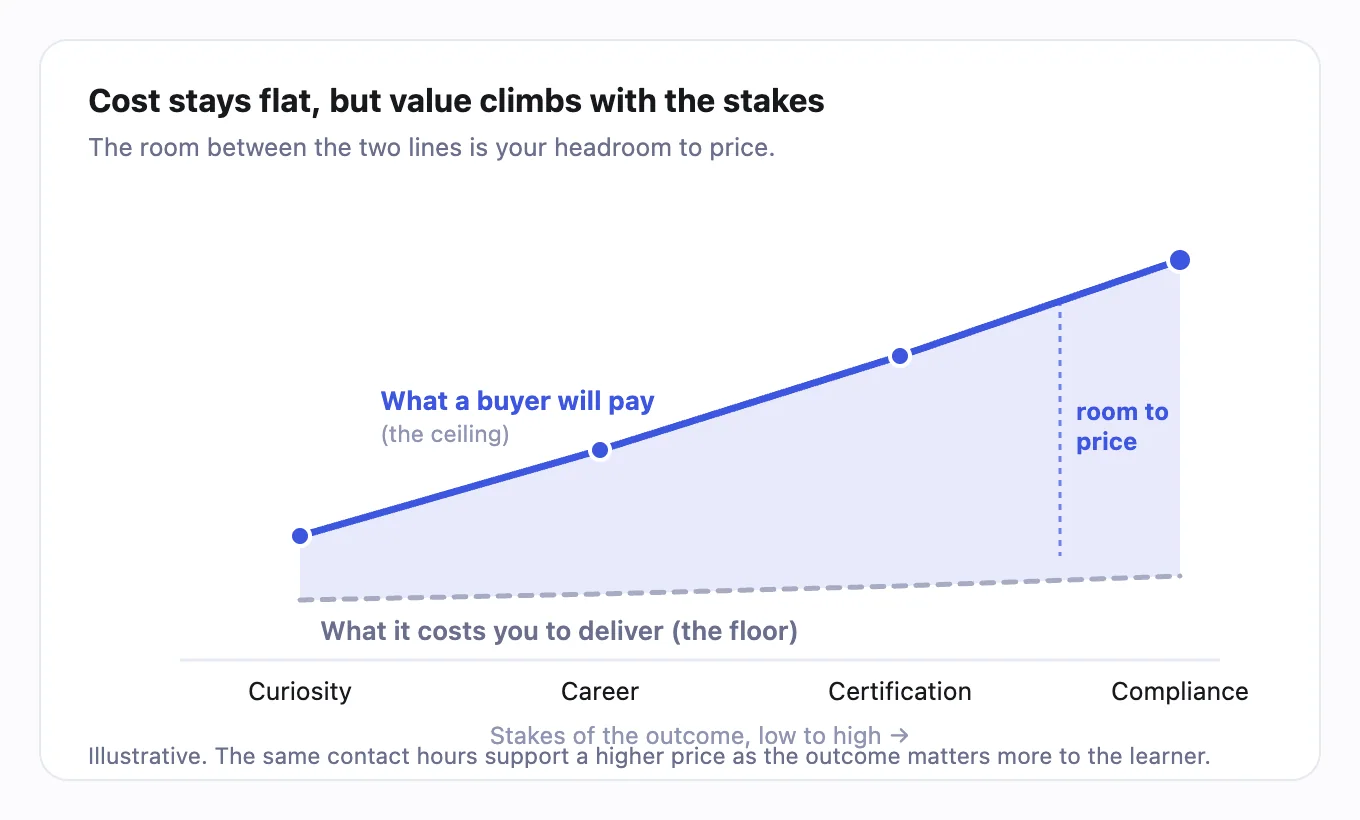
This is why two courses that cost you almost the same to deliver can carry very different prices. A first-aid certificate that lets someone keep their job is worth far more to the buyer than a general interest workshop of the same length, and pricing them alike undercharges the first. A credential from a recognised awarding body is a large part of that worth, which is why the accreditation fees sitting in your floor tend to earn their keep at the ceiling. Your ceiling is what the result is worth to the buyer, including what it costs them to go without.
Anchoring helps you find it. Look at what the alternative to your course costs the buyer: a compliance failure, a botched hire, a day of lost productivity, or a competitor’s more expensive programme. Position your price against that alternative. Your ceiling should track the value you create, which is rarely the maximum you could extract and usually well above the price your nerves would pick.
Step 3: Benchmark against your market
Between your floor and your ceiling sits the going rate, and it pays to know roughly where the market lands before you commit. Credible, publicly surveyed day-rate data is thin, and the aggregators that used to publish neat regional tables have withdrawn them as untraceable, so treat any single figure as a rough guide.
What can be sourced, in the UK, puts training-consultant contract rates at roughly £660 to £1,800 a day (ITJobsWatch, Consultancy.uk). A bespoke corporate training day, which bundles your prep, delivery, materials, and margin, is typically quoted well above that, but it is not captured in any public survey. So your most reliable benchmarks are your own cost floor and a few competitor quotes.
The structure matters more than any single number. A day rate is charged per session, not per head, which changes your economics as the group grows. A £3,000 day delivered to 10 people is £300 a head. The same day delivered to 20 is £150 a head. The rate did not move, but the cost to each participant halved.
Where in the band you can sit: expertise and competition
The band tells you the going rate. Where you sit inside it, or above it, depends on how rare your expertise is and how much choice your buyers have.
If few providers can teach your subject, or you are the recognised name for it, you have real pricing power. A proprietary method, a hard-won specialism like confined-space rescue or a niche technical or medical skill, or a strong reputation shrinks the buyer’s list of alternatives. Fewer alternatives means a higher price holds, so specialists can sit at the top of the band or beyond it.
Some segments run the other way. If you sell a standard, widely available course, a basic online food-hygiene certificate or a common first-aid ticket, where buyers line up quotes and compare on price, pricing purely to the outcome only takes you so far. There your levers change: run leaner so your floor is lower, differentiate on the things price shoppers still care about (accreditation, convenience, pass rates, speed to certificate, service), or move upmarket into higher-stakes or bespoke work where the room to price opens up again. Matching the cheapest quote erodes the margin you need to keep running.
Step 4: Choose the model that fits how you sell
With a floor, a ceiling and a sense of the band, the next decision is which model to charge with, and that follows from how you sell.
Match the model to how you sell
Fixed price with good/better/best packages
Price per cohort or per delivery day
Recurring access fee
Price the outcome the client is buying
Established providers often run more than one of these. You might sell an open course per seat, offer the same course to companies as a day rate, and package your recorded material into a subscription. Each model captures a different kind of buyer. The mistake is using the wrong model for a channel, like quoting a per-person price to a corporate client who is buying a day of your time for their team.
Step 5: Use tiers, the biggest lever you are not pulling
Whichever model you land on for individuals, resist the urge to publish a single flat price. One course packaged three ways lets very different buyers say yes to the same thing.
A price-sensitive buyer takes the entry option and still converts, when a single higher price would have lost them. A serious buyer pays more for certification, materials and support, when a single lower price would have undercharged them. Three tiers let each buyer pick the package that fits.
Three is usually the right number, and the middle tier is where the design work goes. Buyers tend to avoid the cheapest option because it feels like a compromise, and few need the most expensive, so a well-built middle tier becomes the obvious choice. The top tier rarely sells. Its job is to make the middle look reasonable.
Course + digital workbook
- Everything in Essentials
- Assessment + certificate
- 6 months content access
- Everything in Certified
- 1:1 coaching session
- Priority support
Illustrative example of packaging one course three ways, not a Cademy price list. Set your own figures from your cost floor and your market’s band above.
Build your tiers around things buyers value rather than around a deliberately weakened cheap option. The upper tiers are the place for extras that cost you little to deliver but mean a lot to the buyer: a certificate issued automatically on completion, extended access to the course material, one-to-one support, or a course forum that keeps learners engaged between sessions. The entry tier should still be a good course, and the upper tiers should add something real. Tiering can lift your average revenue per booking without raising a single headline price.
Protect your price: discounts, deposits, and cancellations
Discounts are the fastest way to erode a price you worked hard to justify, so use them with intent. Time-limited early-bird pricing pulls bookings forward, improves your cash flow and helps you judge demand before the date. Group discounts can fill a room that would otherwise run half empty. What you want to avoid is the standing, always-available discount, because it teaches buyers to wait and resets your real price to the lower number.
Deposits are the other side of protecting your revenue. On high-demand or high-cost courses, taking a deposit at the point of booking changes the psychology of the commitment, and it reduces no-shows and late cancellations. Pair it with a clear cancellation and rescheduling policy. Make it easy for someone to move a booking, so they free the seat for a waitlisted learner instead of vanishing. A seat you can resell is worth far more than a strict penalty you never enforce.
Settle VAT before you publish a UK price. Whether you have to register, and whether you display prices inclusive or exclusive of VAT, changes both the number your buyer sees and the margin you keep. Some training delivered by eligible bodies is VAT-exempt, which is worth checking with an accountant. The mechanics are a topic of their own. Fix the VAT position first and build the headline price around it.
When and how to raise your prices
The price you set today should not be the price you charge forever. Costs rise and the course gets better, and the price stays where it was because raising it feels risky. Build a review into your calendar at least once a year.
A few signals tell you it is overdue. If your courses consistently sell out, you are almost certainly priced too low. If you rarely lose a deal on price, the same is true. If your costs have risen or you have added a certification, better materials or a stronger track record, your price should follow. And if you are sitting at the bottom of your market’s band, make sure that is a choice.
When you do raise prices, a 5% to 15% increase rarely meets resistance, and a larger correction is justified if you have been badly underpricing. Protect goodwill by honouring the old price for anyone who has already booked, and give existing customers notice rather than surprising them at checkout. Most buyers accept a considered increase from a provider they trust, especially when it comes with a clear reason and a little warning.
Grow the revenue behind each course
Raising your price is one way to earn more from a course. Selling the same expertise in more ways is another, and it often has more headroom. Recording an in-person course into an on-demand tier turns work you have done once into a second income stream, and a hybrid format, part in the room and part live online, sells seats beyond the physical room without losing the live experience people pay a premium for. Both are worth planning once the core price is settled.
The method on one page
- 1Work out your true cost per seat
Total the cost table, divide by the seats you realistically fill, add your minimum margin. That is your floor.
- 2Price to the outcome
What is the result worth to the learner? Higher stakes, higher ceiling.
- 3Benchmark against your market
Place yourself deliberately in your local band, rarely at the bottom of it.
- 4Choose the model that fits how you sell
Per seat, day rate, subscription, or value-based.
- 5Package into tiers
Good, better, best, so both ends of the market convert.
To make that concrete, take the course from Step 1. Its floor came out near £320 a seat. A recognised certificate is worth well above that to the buyer, and the market puts similar courses higher still, so you land the main tier around £525 and offer a lighter option at £345 for price-sensitive buyers. Revisit it each year.
Common pricing mistakes
- Pricing by feel. A number that sounds about right is almost always below what the work is worth.
- Costing only the trainer’s time. The floor has to include admin, marketing, platform fees, no-shows, and any awarding-body and certification fees, or your margin is an illusion.
- Dividing by a full room. Cost your seats at the number you realistically fill. The room’s capacity makes every seat look cheaper than it is.
- Pricing on hours. The result is what the learner buys.
- Using another region’s number. A UK day rate converted into dollars is not what a US buyer expects. Price to your own market’s band.
- One flat price for everyone. No tiers means you lose the budget buyer and under-charge the premium one.
- Permanent discounts. An always-on discount is your real price, and buyers learn to wait for it.
- Never revisiting the price. A price set three years ago is almost certainly too low today.
Frequently asked questions
How do I price a training course for the first time? Total your true cost per seat to set a floor, decide what the outcome is worth to the learner to set a ceiling, then position yourself in your market’s band and package the course into tiers.
How much should a bespoke corporate training day cost? Public survey data on day rates is thin, so treat any figure as a rough guide. In the UK, training-consultant contract rates run roughly £660 to £1,800 a day (ITJobsWatch, Consultancy.uk), and a bespoke corporate day, bundling prep, delivery, and margin, is usually quoted higher. The rate is per session, so cost per participant falls as the group grows. Your most reliable benchmark is your own cost floor plus a few competitor quotes.
Should I charge less than my competitors? Rarely. A low price attracts the least committed buyers and signals lower quality to the serious ones. Compete on the outcome and the certification, and price to reflect them.
How many pricing tiers should I offer? Three is usually right. Buyers tend to avoid the cheapest and few need the most expensive, so a well-designed middle tier becomes the natural choice while the top tier makes it look reasonable.
How do I stop no-shows eating my margin? Take a deposit on high-demand courses, send a reminder sequence, and make rescheduling easy so people free the seat instead of vanishing.
How often should I raise my prices? Review at least once a year. If you sell out consistently, rarely lose deals on price, or have added real value, it is time. A 5% to 15% rise rarely meets resistance when you give notice and a clear reason.
Holding the price in the booking system
A good price only pays off if the seats fill and the money lands, and most of the mechanics above are settings in a booking system. On Cademy, a course can take a deposit of 1% to 95% at checkout with the balance due before the course, or monthly instalments. Discounts run by rule (on the total, the number of seats, or the buyer’s organisation) or by code, with start and end dates, so an early-bird offer switches itself off. Companies can pay by invoice on agreed terms with a PO number at checkout. Prices are shown in the currencies your learners pay in, with card payments through Stripe, PayPal or Klarna and invoices posted to Xero.
Sources
- Training Magazine: 2025 Training Industry Report
- BMC: How Much Does Professional Training Cost in the UK?
- UK trainer day rates: ITJobsWatch and Consultancy.uk